

What MRP Live does
MRP Live pushes MRP logic into SAP HANA for fast, large-scope runs (transaction MD01N). It can plan entire plants/MRP areas in one go and, where needed, it transparently calls classic MRP for materials or settings it doesn’t support. You can also force classic for specific materials if required. SAP Help Portal
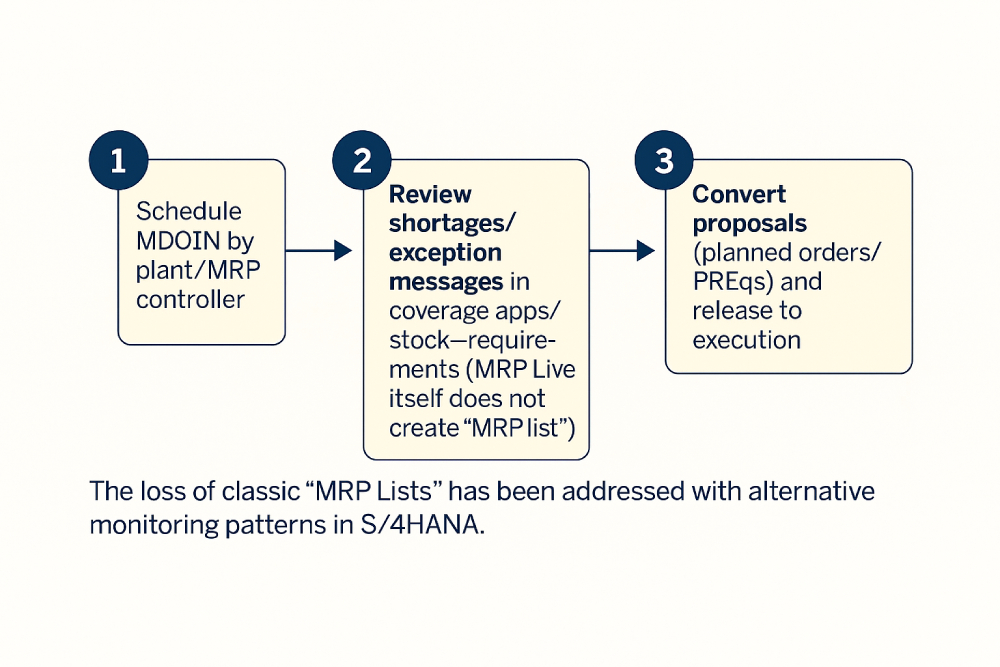
MRP Live workflow (integrated)
- Schedule MD01N by plant/MRP controller;
- Review shortages/exception messages in coverage apps/stock–requirements (MRP Live itself does not create “MRP lists”);
- Convert proposals (planned orders/PReqs) and release to execution. The loss of classic “MRP Lists” has been addressed with alternative monitoring patterns in S/4HANA. SAP Help Portal
SAP Community
Governance for MRP Live
Define when to run Live vs. classic (document the forcing rules), standardize selection variants/scope, and audit changes that impact planability (lot-sizing, special procurement). Maintain a RACI for who can switch planning modes and who reviews exceptions before conversion.
Known downsides with MRP Live
Early projects hit limits where certain settings/materials were not supported by MD01N and had to fall back to classic; teams also struggled with the disappearance of MRP Lists, requiring process and UI change-management. Check SAP Note 1914010 for up-to-date restrictions and plan a mitigation path per material.
SAP Help Portal
Scribd
SAP Community
What Demand-Driven Replenishment (DDR/DDMRP) does
DDR implements DDMRP in SAP: you position decoupling points and maintain buffers to dampen variability and trigger supply only when buffers are consumed. In SAP’s reference architecture, SAP IBP handles positioning/sizing/adjustment of buffers; S/4HANA then generates supply during the planning run.
SAP Help Portal
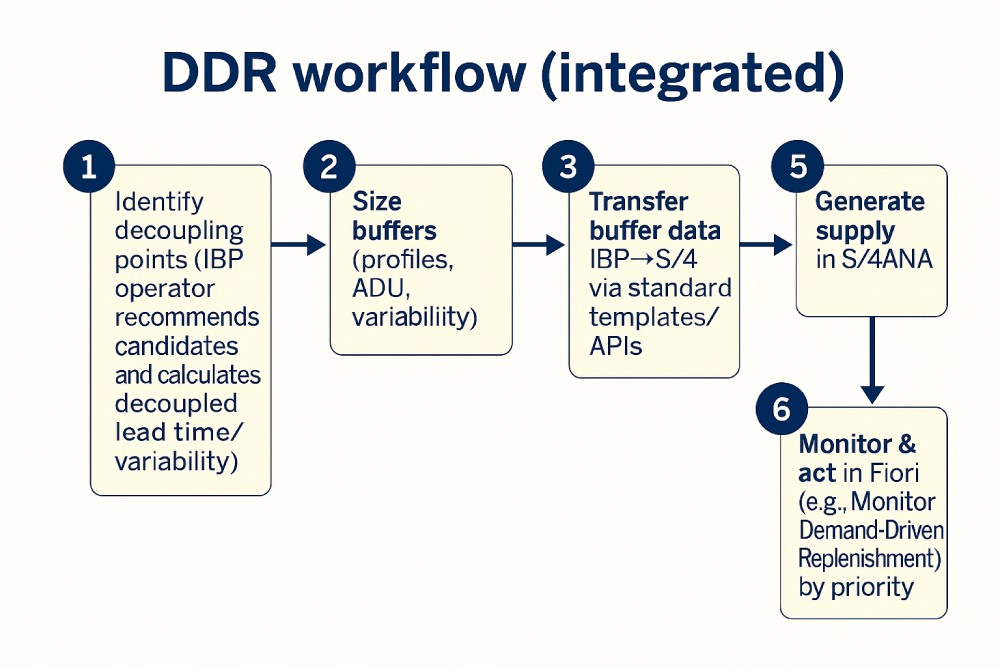
DDR workflow (integrated)
- Identify decoupling points (IBP operator recommends candidates and calculates decoupled lead time/variability);
- Size buffers (profiles, ADU, variability);
- Adjust dynamically;
- Transfer buffer data IBP→S/4 via standard templates/APIs;
- Generate supply in S/4HANA;
- Monitor & act in Fiori (e.g., Monitor Demand-Driven Replenishment) by priority.
SAP Help Portal
+2SAP Help Portal
+2SAP Fiori Apps Library
Governance for DDR
Stand up a buffer governance board: who can alter profiles, when buffers are reviewed (e.g., monthly), and how decoupling points are approved. Version buffer changes, require evidence (service levels, variability), and align KPIs (flow rate, ADU accuracy). Ensure IBP↔S/4 integration is owned and monitored.
Known downsides with DDR
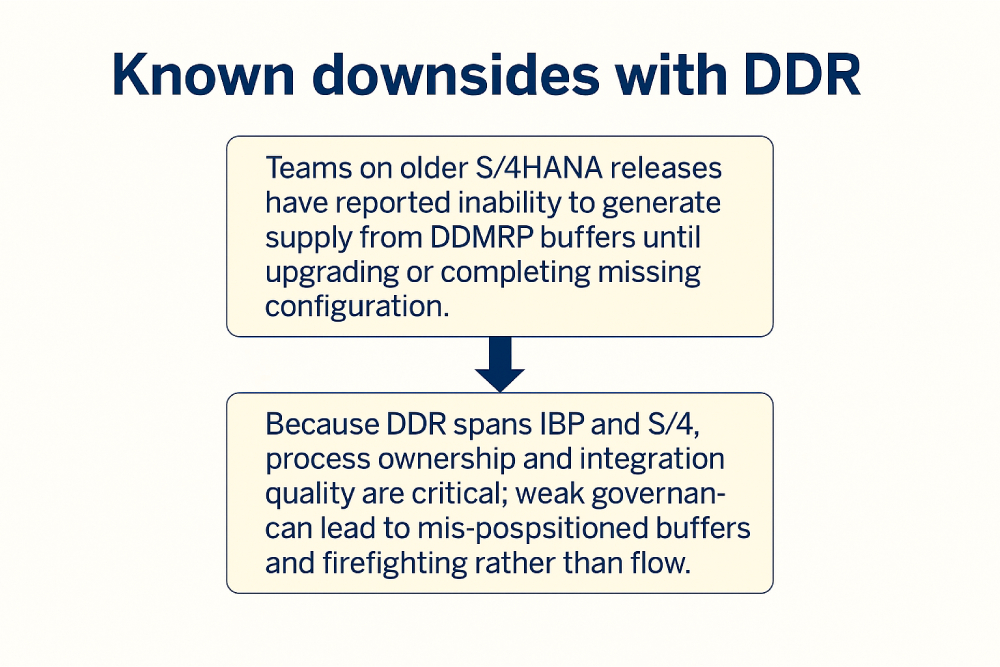
Teams on older S/4HANA releases have reported inability to generate supply from DDMRP buffers until upgrading or completing missing configuration. Because DDR spans IBP and S/4, process ownership and integration quality are critical; weak governance can lead to mis-positioned buffers and firefighting rather than flow.
Putting them together
A pragmatic pattern is: run MRP Live routinely for broad coverage and speed, while applying DDR selectively at chosen decoupling points for flow-based replenishment of volatile/high-impact items. Document when DDR buffers override classic signals, and ensure your exception-handling cockpit reflects both Live-MRP results and DDR priorities.
Key sources: SAP Help (MRP Live/MD01N, DDR), SAP Community blogs and notes (e.g., 1914010), and IBP integration guides.
SAP Help Portal
SAP Help Portal
SAP Help Portal
SAP Community